
Shiro Tsujimura: Ceramics and Heart
Building this hut,
painting, ceramics, selling my wares—
these are all one
and the same thing for me.
Overview
Shiro Tsujimura is a singular, world-renowned ceramic artist.
Since the early 1970s, he has been based in the mountains of Nara, where he established a unique practice that seamlessly integrates daily life and artistic creation, built entirely from the ground up. His work has been widely introduced through numerous exhibitions and museum presentations both in Japan and internationally.
This website serves as a living archive. In addition to showcasing his latest works, it functions as a comprehensive record of his journey, documenting his past activities and preserving essential archival materials.
Profile
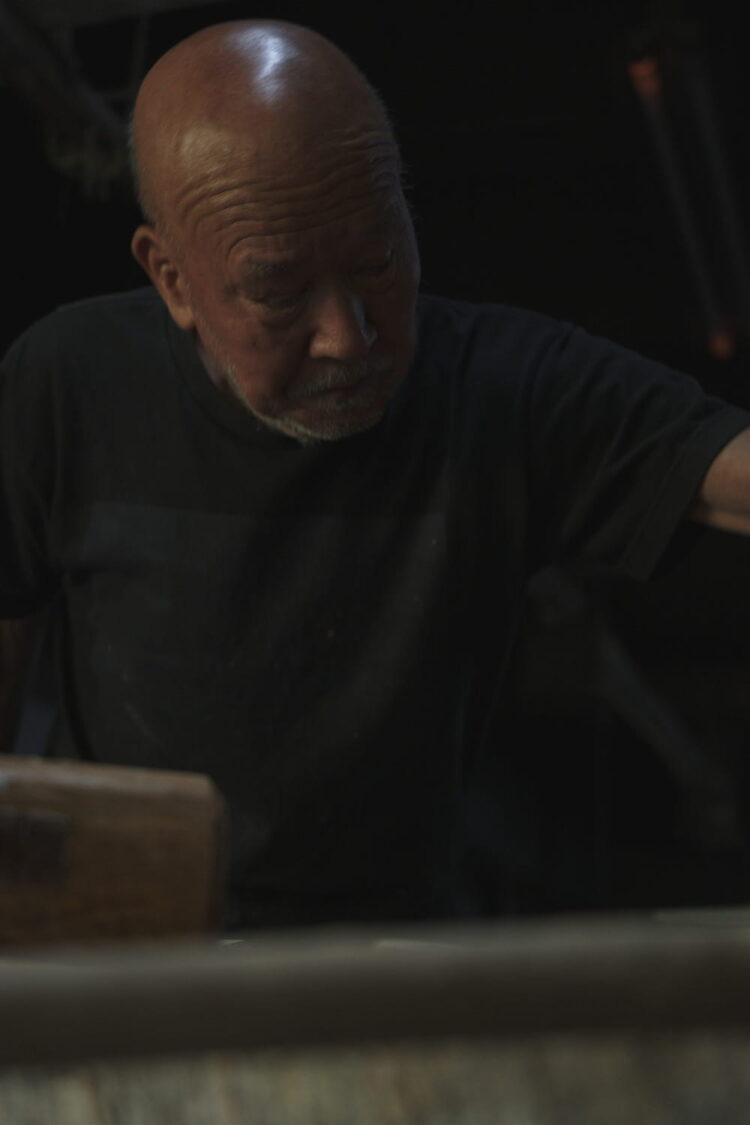
Shiro Tsujimura
Born in 1947 in Gose, Nara Prefecture, Japan.
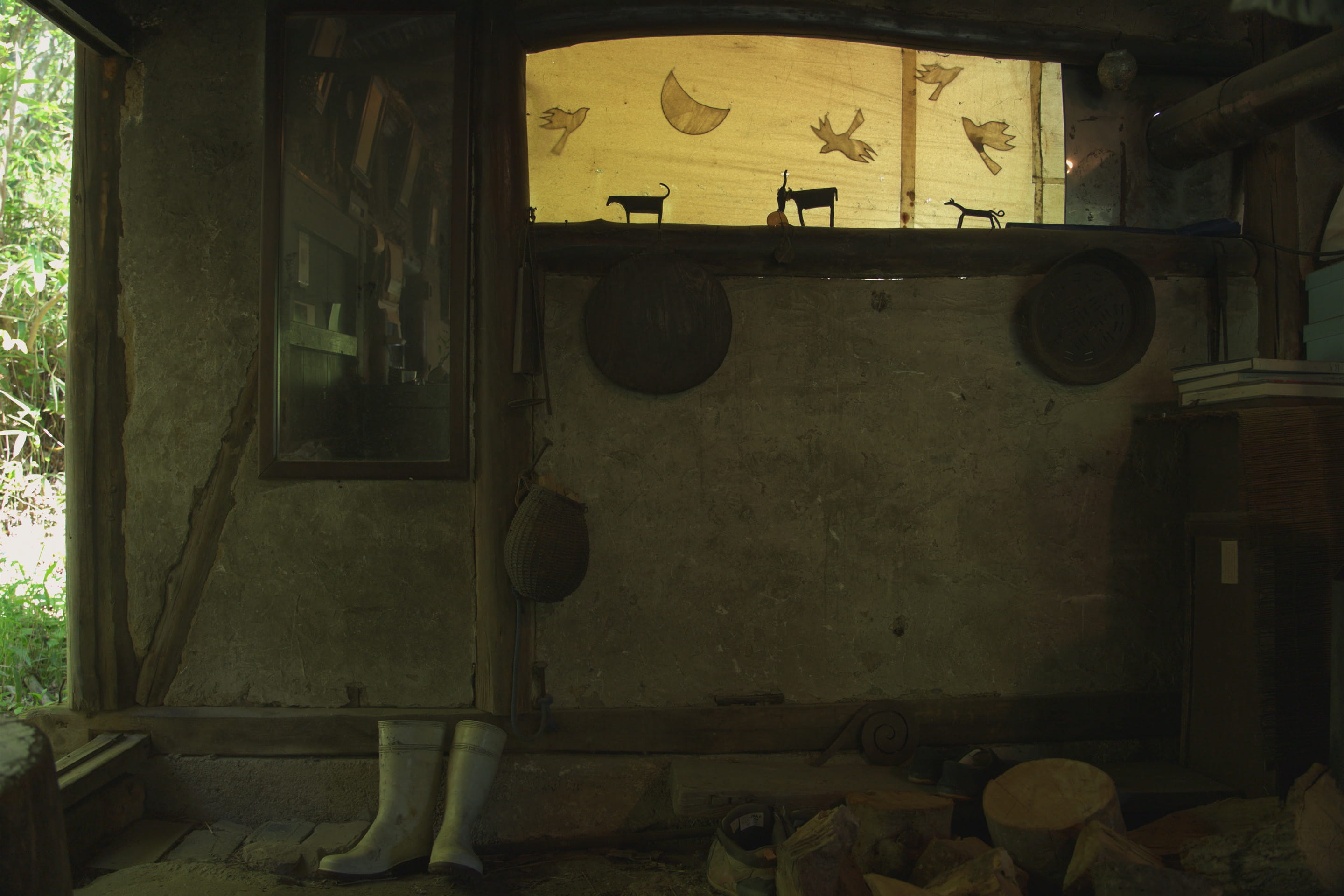
In 1971, he began creating ceramics as a self-taught artist. In 1972, he purchased land in the mountains of Mima, Nara, where he independently built a kiln, studio, tea room, and residence using reclaimed materials.
While primarily working in ceramics, he also creates paintings and calligraphy. His works are included in the collections of numerous museums and institutions in Europe and North America, including the Metropolitan Museum of Art. He has also created works abroad.
His work has been exhibited internationally at museums, galleries, and cultural institutions in cities such as London, New York, and Paris. He has established a strong international collector base.
Public Collection
- U.S.A.
Ackland Art Museum The University of North Carolina at Chapel Hill, Museum of Fine Arts, Boston, The Brooklyn Museum of Art, The Art Institute of Chicago, Cleveland Museum of Art, Freer Gallery of Art and Arthur M. Sackler Gallery, The Metropolitan Museum of Art, The Minneapolis Institute of Arts, North Carolina Museum of Art, Philadelphia Museum of Art, Asian Art Museum of San Francisco, Spencer Museum of Art, Clark Center, The Burg Foundation
- Germany
Frankfurt Craft Museum, Museum of East Asian Art, Berlin
- Japan
Chado Research Center Gallery Kyoto, Miho Museum
- Sweden
Stockholm Museum of Art
- United Kingdom
The British Museum
Selected Exhibitions
A record of selected exhibitions from the 1970s to the present can be viewed here.
Chronology
-
1947
Born on May 6 in the city of Gose, Nara prefecture, Shiro Tsujimura is the youngest of four boys in a family of cattle breeders. His name—the first character of which means “history” (shi, fumi), and reflects the hope that he will grow up to be a person who will leave his mark on history—was to have been read “Fumirō,” but he is always called “Shiro” (spelled without a macron).
-
1951
Age 4
In kindergarten, he loves to draw and is praised by teachers for his drawings of toys.
-
1963
Age 16
He enters Nara Prefectural Fifth High School. He continues to draw and admires the style of Toshiyuki Hasegawa (1891–1940), who, at the time, is hailed as “Japan’s Van Gogh.” He heads to Tokyo, with aspirations of becoming a painter.
-
1966
Age 19
Realizing that to succeed as a painter he must enter the Tokyo University of the Arts, he takes, but fails, the entrance exam. He passes the entrance exam for Tama Art University but does not enroll. He seeks to study with several artists whom he randomly finds in an art directory but is turned away. His interest in Zen arises from his realization that he needs to find himself.
-
1967
Age 20
He enters the Nara Sōtō Zen temple Sanshoji and begins training. He shaves his head, dons priests’ robes, wakes at 4:30 a.m., meditates, reads sutras, cleans, and performs temple chores month after month.
-
1968
Age 21
He becomes an itinerant priest in training, traveling around the Tōhoku region. At Mount Kurikoma (Miyagi prefecture), he goes into the mountains with only rice for a one-week retreat.
-
1969
Age 22
He returns to Tokyo and enters Takami Art Research Institute (then in the Meguro area of Tokyo). He devotes himself to sketching and oil painting. The atmosphere is free and open, and fellow artists pursue not only painting but also ceramics, sculpture, and other arts. In this environment, he tries his hand at making teabowls and other pottery. He meets Mieko Sugiyama, a native of Akita.
-
1970
Age 23
At the Japan Folk Crafts Museum (Mingeikan, Meguro, Tokyo)—which was built to house pieces collected by members of the folk crafts movement that was founded and led by art critic and philosopher Sōetsu Yanagi (1889–1961)—Tsujimura is deeply inspired by a large oido teabowl, which was made by an anonymous Korean craftsman.
-
1971
Age 24
He resolves to make pottery. Returning to his native town of Gose, he begins to make pottery while helping with the cattle-breeding business. He works on the farm during the day and makes teabowls, vases, and other pieces after work, until late at night. He devises his own potter’s wheel by attaching a motor to the wheel of a farm machine and builds one of the simplest direct-flame kilns.
After making pottery for three months, he begins to sell it on the street in Kyoto by spreading his wares outside places like Nanzenji temple or Kyoto National Museum, as well as in the countryside of Ōhara (north of Kyoto). Mieko helps him, and they sell his wares in two locations. They support themselves in this way for seven years.
-
1972
Age 25
After searching for a spacious piece of land in an unpopulated area where he can pursue his creative work freely, he purchases around three-quarters of an acre (3,000 m²) in the mountains of Mima, in the foothills east of Nara. Living for a while in a tent—despite the 5°F (-15°C) temperatures in winter—he and Mieko clear the woods and build a kiln, a teahouse, and a home for themselves, carrying out the excavation, carpentry, plastering, and other tasks themselves, with occasional help from friends.
In response to the period of rapid economic growth at this time, Shigaraki—one of Japan’s oldest pottery-making centers located nearby—replaces its old brick-constructed noborigama kilns with modern electric or gas-fueled ones. The perennial maverick, Tsujimura retrieves bricks from the dismantled Shigaraki kilns to build his own kiln for his unique pieces, just as Shigaraki turns to mass production; he hauls the bricks to Mima in a two-ton secondhand truck. He and Mieko also receive and salvage lumber, roof tiles, and earth for plastering walls. By August, they have built a small 430-sq.-ft. (40-m²) cottage to replace their tent, and they finally install glass in the windows in late fall. The studio and workshop are built over the next two years.
-
1973
Age 26
He marries Mieko Sugiyama, who, like himself, is the youngest of four siblings.
-
1974
Age 27
He writes “Pottery and Heart,” published in Osaka Shōbō [magazine], nos. 293 and 295.
-
1975
Age 28
Birth of son Yui.
-
1976
Age 29
Birth of son Kai.
-
1977
Age 30
By this time, he has built around ten kilns, most of which are direct-firing anagama or cave-type kilns that burn crude petroleum (waste oil) as fuel, disregarding the contemporaneous superstition that ceramicists should exclusively use wood-burning kilns. He experiments with variously shaped kilns to see how the slope of the terrain, the size, and the shape of a kiln affect the results of firing, but he never makes test pieces.
In May, to commemorate his thirtieth birthday, he holds his first solo exhibition on his property, displaying works in four locations, including the house, teahouse, and outlook pavilion. He makes an exhibition catalog in the form of a traditional hand-sewn booklet, writing the content by hand, photographing the works himself, and pasting the photos into the booklets. The exhibition is a great success, clogging the mountain road with visitors’ cars.
-
1978
Age 31
Solo exhibition at Mitsukoshi Department Store,* Osaka, organized after an introduction from Kōsaku Nukada, a dentist who had visited the 1977 exhibition. Works in the exhibition catch the eye of antique dealer Kingo Kondō (1921–2000). Tsujimura goes on to hold exhibitions in almost all of the major department stores around Japan.
*During the rapid economic growth period of the 1960s to 1980s, Japan’s department stores were crucibles of culture, equipped with large exhibition halls that presented major art exhibitions, which today would be held in national museums or private art galleries. Themes were as varied as the ancient Mayan civilization, Persian art, and Picasso. Department stores benefited from such exhibits to develop their corporate image, attract customers, and reinvest profits by contributing to the advancement of culture. It was a great honor for a previously unknown artist to hold a solo exhibition in a department store, and the Mitsukoshi Department Store was among the most prestigious of its kind.
-
1981
Age 34
He holds an exhibition of pottery and paintings in Tokyo. From this time onward, he holds annual solo exhibitions—sometimes as many as seven in a year.
Deeply impressed by the sight of the Five Hundred Arhats of Hōjō at Rakanji temple in Kasai, Hyōgo prefecture, he begins etching arhat motifs into vases or jars from now on.
-
1982
Age 35
Prompted by the Five Hundred Arhats of Hōjō, he begins painting again. Turning the outlook pavilion—the highest point on his property—into a studio, he paints hundreds of works, using canvas and oil paints. He uses white oil paint not only as paint but as adhesive, applying charcoal powder and ash from the kilns to the surface of his paintings.
He goes to Pakistan with Kōsaku Nukada. Upon his return, the Silk Road becomes a major theme in his work.
He encounters ceramic artist Toyozō Arakawa (1894–1985; Living National Treasure) by chance at Kingo Kondō’s shop while visiting with some of his works. Arakawa highly praises his pieces, declaring, “This man makes his own works according to his own sensibilities; he imitates no one.” Then, much to Kondō’s surprise, Arakawa asks Tsujimura to sell him a nicely fired cylindrical Iga-style flower vase; Kondō is surprised again when the young potter promptly refuses the request.
-
1983
Age 36
He opens his first solo exhibition overseas, in New York, through a project organized by photographer and contemporary artist Hiroshi Sugimoto (b. 1948). He subsequently holds numerous international exhibitions in the United States, the United Kingdom, Germany, Italy, France, and Belgium, among other countries.
-
1984
Age 37
He donates fifty kohiki slipware teabowls to the MOA Museum of Art in Atami, Japan.
-
1985
Age 38
In a review for the monthly journal Tōsetsu, ceramic specialist Yoshiharu Sawada is unstinting in his praise for Tsujimura’s virtuosity as an artist and the outstanding shapes of the teabowls and jars featured in his solo exhibition at Mitsukoshi Nihonbashi. Sawada favorably reviews Tsujimura’s works in various publications, applauding his originality and the sophistication of his aesthetic.
-
1986
Age 39
Antique dealer Sōshirō Yabumoto (1914–1987) highly praises Tsujimura’s works and purchases several teabowls and vases. Yabumoto’s clients include the finest art museums in the world, and economist Peter Drucker favors Yabumoto as his advisor regarding Japanese art. Christie’s and other auction houses feature long articles in their publications on the pieces that Yabumoto recommends.
-
1987
Age 40
The Cleveland Museum of Art in Ohio, USA, purchases Tsujimura’s work for their permanent collection.
-
1990
Age 43
He begins using an electric kiln around this time. He uses gas for controlled reduction firing.
-
1991
Age 44
The Spencer Museum of Art in Lawrence, Kansas, USA, purchases a large jar.
-
1993
Age 46
He spends three months in west Devon, UK, building a kiln and primarily making teabowls, vases, and other pottery. He begins using etched lines on the surface of his pottery for the first time, and adds decoration in the Oribe style.
His elder son, Yui, begins ceramic work.
-
1994
Age 47
He exhibits works produced in west Devon at a London gallery. Musician Eric Clapton visits the exhibition and purchases a round Shigaraki-style jar and hikidashi-guro teabowl.
His second son, Kai, begins ceramic work. The brothers absorb their father’s savoir faire. Tsujimura encourages them not to compromise, but to aim for their own distinctive style.
-
1997
Age 50
He begins practicing calligraphy.
-
1999
Age 52
He mounts Jars and Teabowls, his first exhibition in an art museum, at the Chadō Shiryōkan (Chadō Research Center Gallery) in Kyoto. This is only the second exhibition of a living artist ever held at the gallery.
-
2003
Age 56
He begins making round jars using a jigger and jolly apparatus. He presents a lecture with slides on his pottery at the Metropolitan Museum of Art in New York; he gives the same lecture at the San Francisco Museum of Modern Art.
-
2006
Age 59
Belgian interior designer and art collector Axel Vervoordt visits Tsujimura’s home.
-
2007
Age 60
He presents Torn Jar in the Axel Vervoordt Gallery group exhibition, alongside works by Lucio Fontana (1899–1968), at the fifty-second Venice Biennale. He subsequently visits Venice several times.
-
2009
Age 62
French president Jacques Chirac visits Tsujimura’s solo exhibition in Paris and spends several hours observing his demonstration using an electric potter’s wheel. The exhibition sponsors present the president with a hikidashi-guro teabowl resembling Raku ware.
-
2011
Age 64
He appears in the NHK (Japanese Broadcasting Corporation) BS Premium channel series Takeshi Art Beat (third episode).
He takes part in a week-long residency in Cologne, Germany, for Nobuyoshi Araki and Shiro Tsujimura: Work in Progress, a two-man exhibition with photographer Nobuyoshi Araki, which runs from October 29, 2011 to March 5, 2012 at the Museum of East Asian Art, Cologne.
-
2012
Age 65
He presents exhibitions of jars in Paris and Nancy, France, and in New York, USA. The latter exhibition is highly praised in the New York Times (November 2).
-
2013
Age 66
He holds a pottery demonstration and exhibition in Victoria, Australia. To achieve the hidasuki technique of fire markings on the pottery—as in Bizen ware—he uses lemongrass instead of rice straw in Australia.
Tsujimura has been creating works on paper since his early years and now, while looking for authentic papers to improve his works, he meets with Kami Ya Co., Ltd., and the gallery provides him with support for his paper works. From now on, he uses authentic Japanese and Chinese papers, as well as sumi ink from the Qing dynasty.
-
2016
Age 69
From the previous year to the end of winter 2016, he produces a large series of black teabowls. Mieko remarks, “It’s been all black pieces since last year. He just keeps making and firing, making and firing, without pause.” He exhibits these black teabowls in Tokyo in February 2016.
-
2018
Age 71
While residing in Sydney, Australia, he teams up with son Kai for a three-day pottery-making session at the University of Sydney. He holds his first public calligraphy performance in Antwerp.
From September 1 to November 17, he presents the Shiro Tsujimura: A Way of Wabi exhibition at Axel Vervoordt Gallery, Kanaal, Wijnegem, Belgium.
-
2021
Age 74
Tsujimura’s life and work are portrayed in the NHK series The Professionals, in “Creation is Life: Shiro Tsujimura, Ceramic Artist.” Original and unnarrated versions are rebroadcast.
-
2022
Age 75
He continues making Shino-style teabowls, which he began in 2021; he uses more than 330 lb. (150 kg) of the glaze alone. He unloads his kiln thirty-two times in the nine weeks between New Year’s Day and early March.
The exhibition Shiro Tsujimura is held at the Terrace Gallery at Axel Vervoordt Gallery, Kanaal, Wijnegem, Belgium, from February 19 to May 7.
The solo exhibition Shiro Tsujimura: 100 Works is presented at Zenbi (Kagizen Art Museum) in Kyoto, from April 23 to August 21.
From May 13 to June 19, he holds his second solo exhibition in a Japanese art museum since 1999, at the Museum Eki Kyoto, on the seventh floor of the Isetan Department Store at Kyoto Station. The retrospective exhibition reviews fifty years of his work as an artist.
Shiro Tsujimura is held at the Imura Art Gallery, Kyoto, from May 20 to June 10.
From July 20 to September 15, Shiro Tsujimura: Fire and Ash is held at the Yoshii Gallery, New York, USA.
On July 24, “Mountains of Ceramics by Shiro Tsujimura,” featuring his way of life as a ceramic artist, airs on NHK in the series Sunday Museum of Art.
-
2023
Age 76
The exhibition Shiro Tsujimura: Ceramics is held at Odo, The Gallery, New York, USA, from September 9 to December 17.
A Message from the Executive Committee
This website is curated and managed by the Executive Committee with the purpose of documenting and conveying the works and activities of Shiro Tsujimura through a long-term historical lens.
Shiro Tsujimura’s works have spread to diverse locations, each evolving its own unique “scenery” (keshiki) over time. On this site, we prioritize accurately preserving his path by gathering not only current pieces but also archival materials such as past creations, exhibition records, films, and texts. Furthermore, it is our hope that the provenance of pieces sold will be recorded here, allowing their history to be read and passed down to future generations.
We hope this site serves both as an entry point for encountering his work and as an academic resource to which one can repeatedly return. The Executive Committee will continue to update this platform to ensure that Shiro Tsujimura’s expression is shared appropriately and handed down to the next generation.
Acknowledgements
In managing this site, we would like to express our deepest gratitude to the artist himself, as well as the following institutions and individuals for their invaluable cooperation:
- ME NO ME -Japanese Arts and Antiques
- Studio Kentaro Nakamura
- imura art gallery
- Kobijutsu Kondo
- KOU KYOTO
- Mikako Muramatsu
- Shigeyoshi Suzuki
- Masato Tanoue
- Nobutada Omote
- .m